


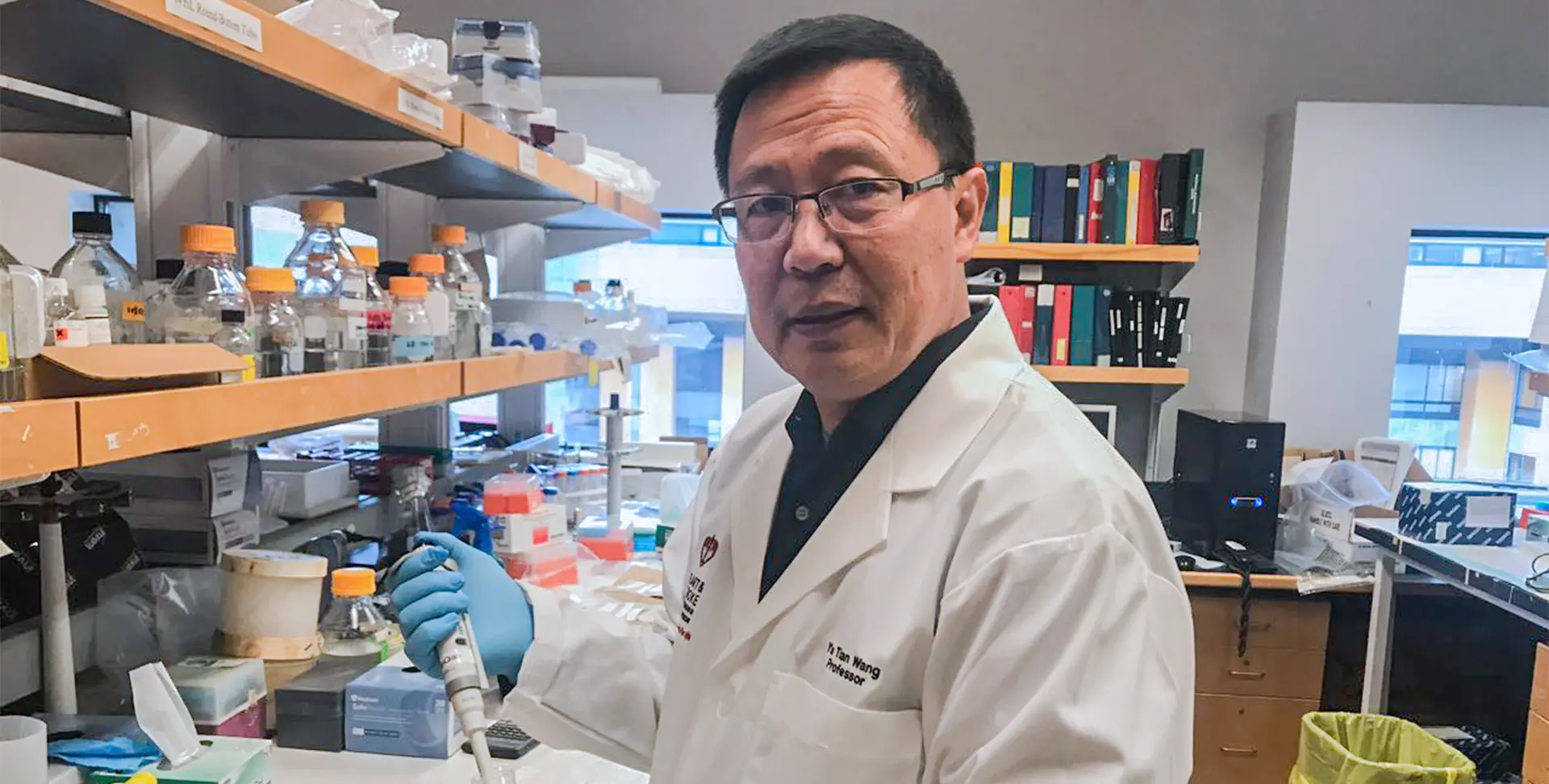
Saving brain cells when every second counts
Dr. Yu Tian Wang’s research could lead to drugs that protect the brain before stroke treatment begins.
Every second after a stroke can shape what comes later: whether someone can still speak clearly, move independently, solve everyday problems and interact with others as they did before. While stroke treatments have advanced over the past three decades, they can’t begin until doctors know whether a stroke was caused by a blood clot or bleeding in the brain. Getting to a hospital, undergoing brain imaging and receiving a diagnosis can take up to three hours. In the meantime, vital brain cells are dying.
For more than 40 years, Dr. Yu Tian Wang has worked to develop a new class of drugs that could protect the brain in the earliest moments of a stroke, before a diagnosis can be made. He contributed to the early development of the experimental NA-1 therapeutic treatment, and more recently has led research on A30, a next-generation treatment. If successful, these drugs could help preserve brain function during the critical hours when treatment options remain uncertain — buying precious time.

For more than 40 years, Dr. Yu Tian Wang has been researching treatments to protect the brain from stroke damage.

Dr. Wang has devoted his career to developing neuroprotective drugs that people could take from the first signs of stroke.

Dr. Wang sees a future where paramedics and local healthcare providers could start administering these treatments, before the type of stroke is diagnosed through imaging.
An internationally respected researcher, Dr. Wang has served as Heart & Stroke’s B.C. & Yukon Chair in Stroke Research, a professor in the Division of Neurology at the University of British Columbia, and an investigator at UBC’s Djavad Mowafaghian Centre for Brain Health. As Dr. Wang transitions into retirement, his team is carrying his transformative work forward, with continued funding from Heart & Stroke.
Dr. Wang talked with us about his legacy, the promise his research is showing, and his hope that future stroke patients will not only survive but thrive and return to living their full lives.
What motivated you to devote your career to stroke and brain health research?
During my internship, I rotated through many departments, and I was particularly affected by patients in the neurology ward. The brain is the most complex organ we know, and its remarkable functions sparked my curiosity.
More than 40 years ago, we knew very little about stroke. We saw patients suffering and had few ways to help them. I felt the only way to change that was to better understand how the brain works so we could develop effective treatments.
What is neuroprotection, and why does it matter during a stroke?
Neurons are brain cells that send and receive messages, helping the brain and body communicate. During a stroke, brain cells can quickly become damaged or die because they are deprived of oxygen. Neuroprotection is about keeping those cells alive when oxygen levels are low, reducing brain damage, improving recovery and potentially saving lives.
How could neuroprotective drugs change the way stroke is treated?
Some stroke treatments can only be given after brain imaging confirms whether the stroke was caused by a blocked blood vessel or bleeding in the brain. That can take hours, depending on where you live.
A neuroprotective drug would target the processes that cause brain cells to die rather than the clot or bleeding itself. It could potentially be given by paramedics, on the scene or in the ambulance, or during triage in the emergency room, as soon as a stroke was suspected. This would protect the brain while doctors determined the type of stroke and the most appropriate treatment.

Could an ordinary person potentially administer neuroprotective drugs, if they recognized the signs of a stroke?
Researchers have discussed the possibility of eventually developing a self-injection device, similar to an EpiPen, that could be used at the first signs of stroke. This would require further research, clinical trials and clear protocols to ensure the drugs could be used safely and effectively.
How did your early research shape the discoveries that followed?
In the early 2000s, at the University of Toronto and SickKids, I was fortunate enough to collaborate with Dr. Michael Tymianski on the development of a drug called NA-1.
NA-1 was designed to block one of the signals that causes brain cells to die during a stroke. That work inspired my focus on neuroprotection.
What progress has been made with NA-1 since those early days?
I have not been directly involved in NA-1’s recent clinical development, but I remain on the scientific advisory board of NoNO Inc., the company six of us founded after early laboratory studies showed promise.
Several large clinical trials have shown benefits when NA-1 is given within three hours of stroke symptoms starting. The research suggests it may increase the chances of recovering with little or no disability. It would reduce the risk of the most severe outcomes. However, individual results can vary and can’t be predicted.
How have you been building on that work with A30?
We’re now developing A30, a next-generation neuroprotective treatment. While NA-1 blocks signals that cause brain cells to die, A30 is designed both to block those signals and promote brain cells survive and repair.
The two drugs could potentially be used together early after a stroke, with A30 continuing beyond the first few hours to support brain cell recovery.
When might A30 become available to patients?
A30 is still being studied in the laboratory, and a patent application has been submitted. It must go through further research, preclinical testing and three phases of clinical trials before it can be approved for use. An optimistic estimate would be at least eight to 10 years.
What could neuroprotective treatments mean for people in remote or under-served communities?
They could make a dramatic difference. These people may not be able to get to a hospital with the facilities needed to diagnose and treat stroke within the early treatment window. A paramedic or local medical professional could start protecting the brain before diagnostic testing is complete. Saving time means saving brain cells.
What excites you most about where this research could lead?
What excites me most is seeing research move from getting a better understanding of how the body and brain work to improving care for patients. It’s also meaningful when our discoveries allow other researchers and clinicians, working on stroke and other brain conditions, to investigate neuroprotection in new ways.
Although I’m entering retirement, the A30 project is continuing. I still visit the laboratory and am summarizing roughly 20 years of work so the person who succeeds me in leading this research can build on what we've learned and move things forward.
What has Heart & Stroke support meant to you as a researcher, and what would you like donors to know about their impact?
Heart & Stroke support has helped us attract talented students, trainees and researchers and provided the resources needed to move promising discoveries closer to helping patients.
Its impact reaches far beyond my own laboratory. Scientists trained in our Canadian laboratories come from — and return to — academic institutions and hospitals across the world, where they continue to work on heart- and stroke-related projects.
Medical research is a long journey that requires sustained support. The generosity of donors helps researchers turn discoveries into better treatments and care for patients.

Real stories, real impact


A love story saved

The comeback she wrote
Natalie’s story ends with a new beginning.
